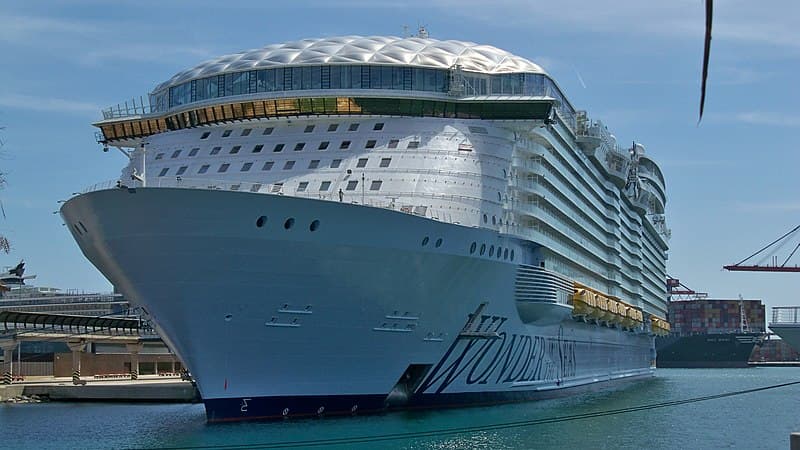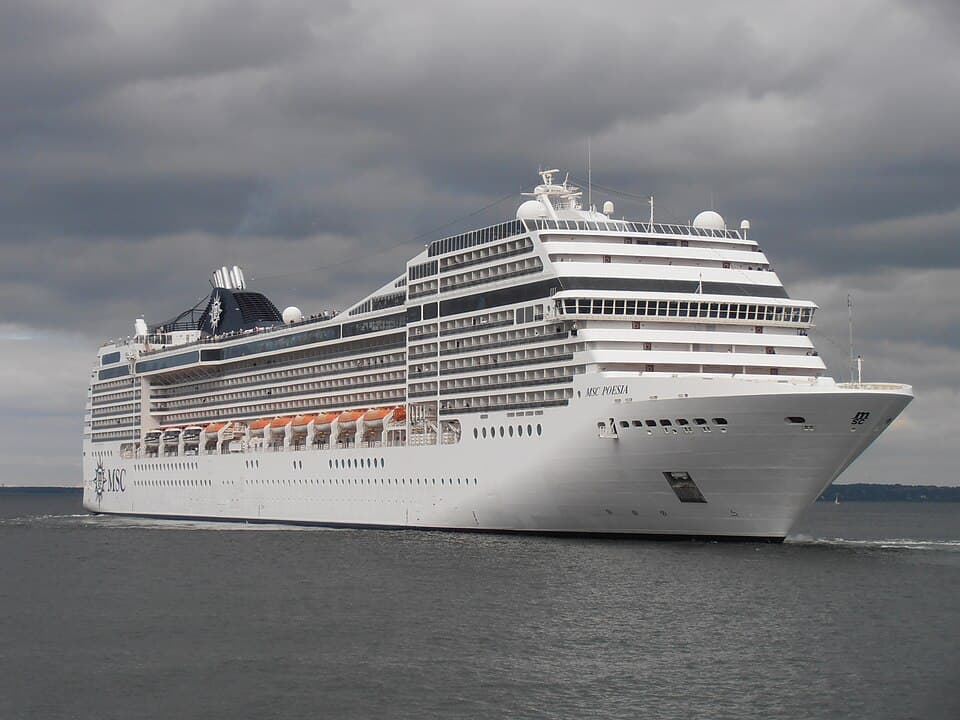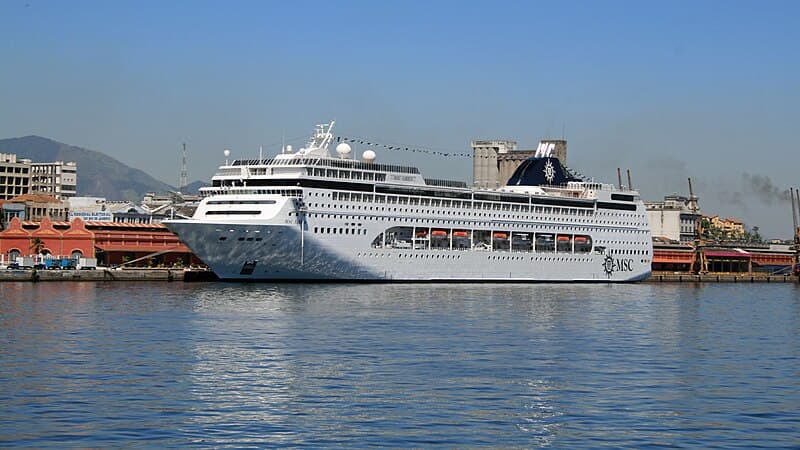
Stand on a dock next to a modern cruise ship and the question almost asks itself. The thing is the size of a skyscraper laid on its side, stacked fifteen or twenty decks high, topped with pools, waterslides, and a small forest of antennas. It looks like it should be desperate to fall over. So why doesn't it? Why don't all those decks make it tip the moment a big wave rolls through?
Cruise ships stay upright because the vast majority of their weight sits low in the hull (engines, fuel, and water-filled ballast tanks deep below the waterline) which keeps the center of gravity far lower than the towering decks suggest. That low center of gravity, combined with a wide hull and physics that actively pushes the ship back toward level whenever it tilts, makes a cruise ship one of the most self-righting structures humans build. Stabilizer fins then smooth out the rest.
The "top-heavy" look is an illusion. Underneath the visible cabin decks is a dense, heavy keel doing exactly the opposite of what your eyes expect. Let's break down the physics, then the technology.
The Top-Heavy Illusion: Why Your Eyes Are Wrong
When you look at a cruise ship, you see the part above the water: the decks, the balconies, the glass. What you don't see is everything below the waterline, and that's where the real story lives.
Naval architects deliberately keep the center of gravity as low as possible by placing the heaviest equipment deep within the hull. The engines, generators, fuel, fresh water, and ballast tanks all sit low, near the keel. These are the densest, heaviest components on the entire ship, and they act like the lead weight in the bottom of a child's roly-poly toy. No matter how tall the structure above them, that concentrated low-down mass dominates the balance.
The bright, glassy decks you see are comparatively light. They're cabins, public spaces, and air. So the ship that looks top-heavy is, in reality, bottom-heavy by design, and that distinction is the difference between a vessel that rights itself and one that rolls over.
If you're curious about everything else packed into a modern hull, our cruise ship technology explained guide goes deeper into the systems that keep these floating cities running.
Center of Gravity vs. Metacenter: The Core Physics
To understand stability, you only need two points and one rule.
The first point is the center of gravity (G), the average location of all the ship's weight. Gravity pulls down through this point. Designers work hard to keep it low.
The second point comes from buoyancy. Water pushes up on the submerged part of the hull through a point called the center of buoyancy (B). When the ship floats level and still, gravity pulling down and buoyancy pushing up are stacked in a vertical line, and everything is in balance.
Now tilt the ship. When it heels to one side, the underwater shape of the hull changes, more hull is submerged on the low side. That shifts the center of buoyancy toward the submerged side. Gravity still pulls straight down through the center of gravity, but buoyancy now pushes up from a point that's no longer directly beneath it. Those two offset forces create a righting arm: a lever that twists the ship back toward upright. It's the same self-correcting force that makes a tilted ship swing back to level instead of continuing over.
The geometry behind this is captured by the metacenter (M), the point where the upward line of buoyancy crosses the ship's centerline as it heels. The distance from the center of gravity up to the metacenter is the metacentric height (GM), and it's the single most important number in ship stability.
Here's the rule: as long as the metacenter stays above the center of gravity (a positive GM), the ship generates a righting force and returns to level. If the center of gravity ever rose above the metacenter (a negative GM), the righting arm would flip direction and the ship would keep rolling over. Every cruise ship is engineered with a comfortably positive metacentric height across all its normal loading conditions, which is exactly why keeping the heavy machinery low matters so much.
The Wide Beam: Stability You Can See
There's a reason modern cruise ships are so broad. A ship's beam, its width, is one of the most powerful tools for stability.
A wide hull means that when the ship heels, the center of buoyancy shifts a long way sideways toward the submerged side. A bigger sideways shift produces a longer righting arm and a stronger push back toward upright. The wider the waterline footprint, the harder the ship resists tilting in the first place. This is why a wide hull dramatically increases the righting moment compared to a narrow one.
You can test the principle yourself. A narrow kayak tips easily; a wide raft barely moves when you shift your weight. Cruise ships took that lesson and ran with it. The newest mega-ships are wider relative to their early-2000s ancestors, and that extra beam is part of why they ride so steadily, it's stability you can literally see in the silhouette.
Want to appreciate just how massive these dimensions have gotten? Our breakdown of how big are cruise ships puts the numbers in perspective.
Ballast: Fine-Tuning Stability on the Fly
A cruise ship's balance isn't set once and forgotten. It's actively managed throughout a voyage using ballast water.
Deep in the hull are large tanks that can be filled with or emptied of seawater. As a ship burns fuel, uses fresh water, and as thousands of passengers move around, the weight distribution shifts. The crew compensates by adjusting ballast, adding water low in the hull to lower the center of gravity, or redistributing it side to side to correct any list (a persistent lean to one side).
This is the ship's living, adjustable counterweight. It lets the crew keep the center of gravity in the sweet spot regardless of how the load changes over a week at sea. Ballast, the low-mounted machinery, and the wide beam are the three passive pillars of stability, all working before any moving technology gets involved.
Stabilizer Fins: Smoothing Out the Roll
Here's where the engineering gets actively clever. Even a ship that's perfectly safe and stable can still roll uncomfortably in waves, and roll is what makes passengers seasick. That's the job of stabilizer fins.
Stabilizer fins are large, wing-like surfaces that extend out from both sides of the hull below the waterline. Most retract into the hull when not needed, then deploy at sea. As the ship moves forward, water flows across these fins, and, just like an aircraft wing, they generate lift. By tilting the fins, the system can push one side of the ship up and pull the other down to actively counteract a roll.
What makes them remarkable is the control. A roll sensor continuously measures the ship's roll angle and speed and feeds that data to a controller, which calculates the precise fin angle needed to fight the motion, gyroscopically governed and adjusting many times per second. The fins are constantly anticipating and canceling the ship's tendency to rock.
How effective are they? Modern fin stabilizer systems can reduce a ship's roll by roughly 85 to 90 percent in the right conditions. Some systems and sea trials report up to around 90 percent roll reduction. That's the difference between a noticeable sway and a glassy, barely-there motion.
Two important caveats. First, fins only work when the ship is moving, they need water flowing across them to generate force, so they do little when the ship is stationary or going very slowly. Second, and crucially: stabilizer fins are about comfort, not survival. They reduce the rolling that makes people queasy. The ship's fundamental stability, its ability to stay upright, comes from the hull design, the low center of gravity, and the ballast, all of which work whether the fins are deployed or not. If the stabilizers failed entirely, the ship would still be perfectly safe; it would just roll more.
If queasiness is your concern, our cruise seasickness prevention guide covers what you can do on top of what the ship already does for you.
What Happens in Rough Seas and Big Swells
So what about a genuine storm? Big swells, strong winds, the ship leaning hard to one side?
In rough seas, the same physics simply works harder. The bigger the wave tilts the ship, the farther the center of buoyancy shifts, the longer the righting arm becomes, and the more forcefully the ship is pushed back toward level. The self-righting force scales up with the tilt, which is precisely the behavior you want in heavy weather. A cruise ship leaning in a swell isn't a ship in trouble, it's a ship doing exactly what it was designed to do, then springing back.
Captains add another layer of protection by managing the situation actively. They adjust speed, change heading to take waves at a more favorable angle, and rely on weather routing to steer around the worst conditions entirely. Modern ships rarely meet a storm head-on by accident; they're tracked, forecast, and routed around well in advance.
The result is that the dramatic-looking lean you might feel in rough weather is well within the ship's huge built-in safety margin. Uncomfortable, perhaps. Dangerous, almost never.
Can a Cruise Ship Actually Capsize?
Honest answer: it is physically possible, but extraordinarily rare, and for a ship operating normally, vanishingly so.
For a modern cruise ship to capsize, its center of gravity would essentially have to rise above its metacenter, destroying the righting force that constantly pulls it back to level. In normal operation that simply doesn't happen, because every layer of the design (low machinery, wide beam, managed ballast, positive metacentric height), exists specifically to prevent it.
The rare historical cases of large passenger vessels capsizing involved extreme circumstances well outside normal operation: severe flooding of the hull after a major breach, catastrophic loss of stability from water entering the ship, or human error compounding a casualty. These are failures of an emergency cascade, not of the everyday physics of floating. Naval architecture, international stability regulations, watertight compartments, and crew training are all layered defenses precisely so that a single problem can't snowball into a capsize.
The takeaway isn't "it can never happen": it's that the ship is built, regulated, and operated to make it about as unlikely as engineering allows. The physics is genuinely, reassuringly on your side. For more perspective-shifting numbers about these vessels, our roundup of cruise ship facts is a fun place to keep reading.
FAQ
Why don't cruise ships tip over with so many tall decks? Because the weight you can't see outweighs the part you can. The engines, fuel, and water ballast sit low in the hull, keeping the center of gravity far below the visible decks. That low center of gravity, plus a wide hull, creates a strong self-righting force that pulls the ship back to level whenever it tilts. The "top-heavy" look is an illusion.
How much do stabilizer fins actually reduce rolling? Modern fin stabilizer systems can cut a ship's roll by roughly 85 to 90 percent in favorable conditions, with some systems reporting up to around 90 percent. They work by generating lift as water flows across them while the ship moves, actively counteracting the roll many times per second. Note that they need the ship to be underway to function.
Do stabilizers keep the ship from sinking or capsizing? No, that's a common misconception. Stabilizer fins are about passenger comfort; they reduce the rolling motion that causes seasickness. The ship's actual ability to stay upright comes from its hull shape, low center of gravity, and ballast. If the fins failed, the ship would roll more but remain just as safe.
What keeps a cruise ship stable in a storm? The same righting physics that works in calm seas, scaled up. The harder a wave tilts the ship, the stronger the force pushing it back upright. On top of that, captains manage speed and heading, take waves at favorable angles, and use weather routing to avoid the worst conditions. The lean you feel is well inside the ship's large safety margin.
Can a modern cruise ship capsize? It's physically possible but extraordinarily rare in normal operation. Capsizing would require the center of gravity to rise above the metacenter, destroying the righting force, something the entire design works to prevent. Historical cases involved extreme events like major hull breaches and severe flooding, not everyday sailing conditions.