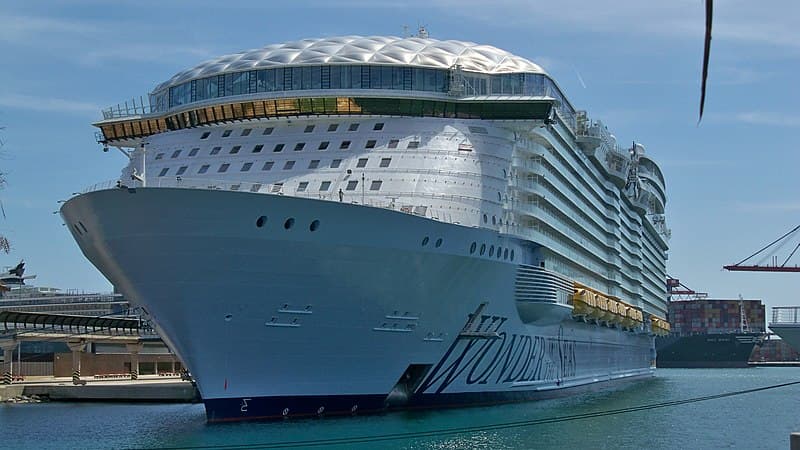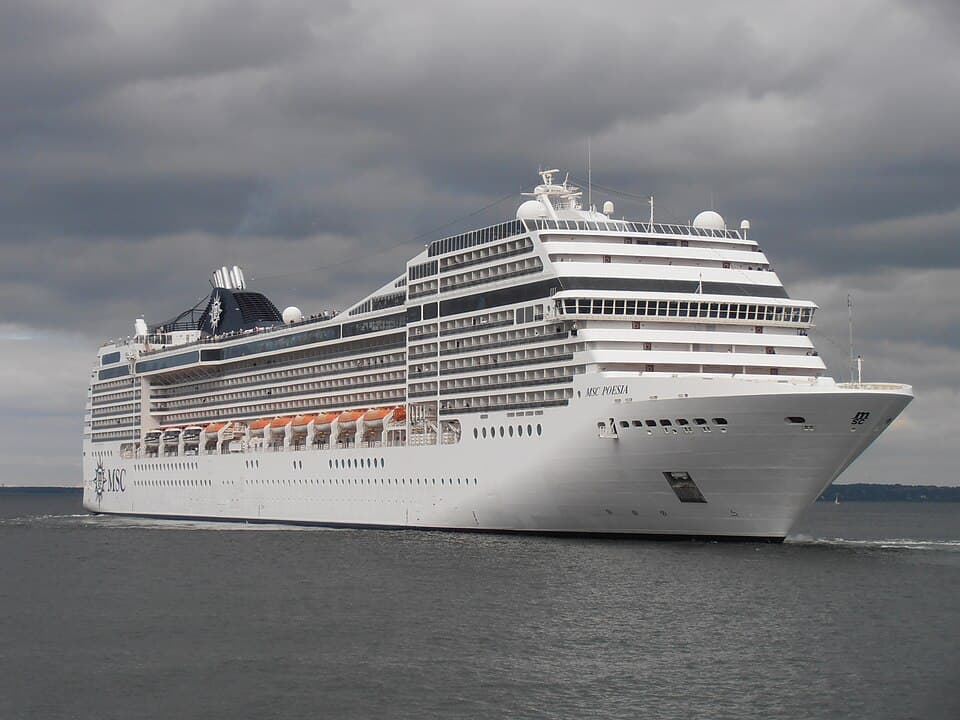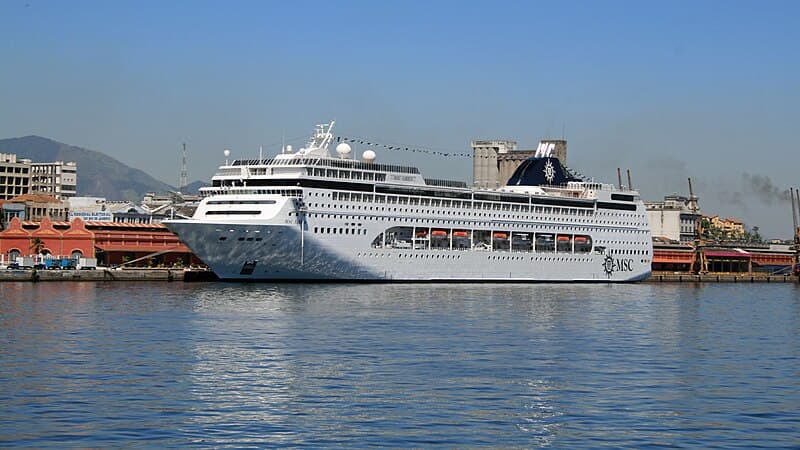
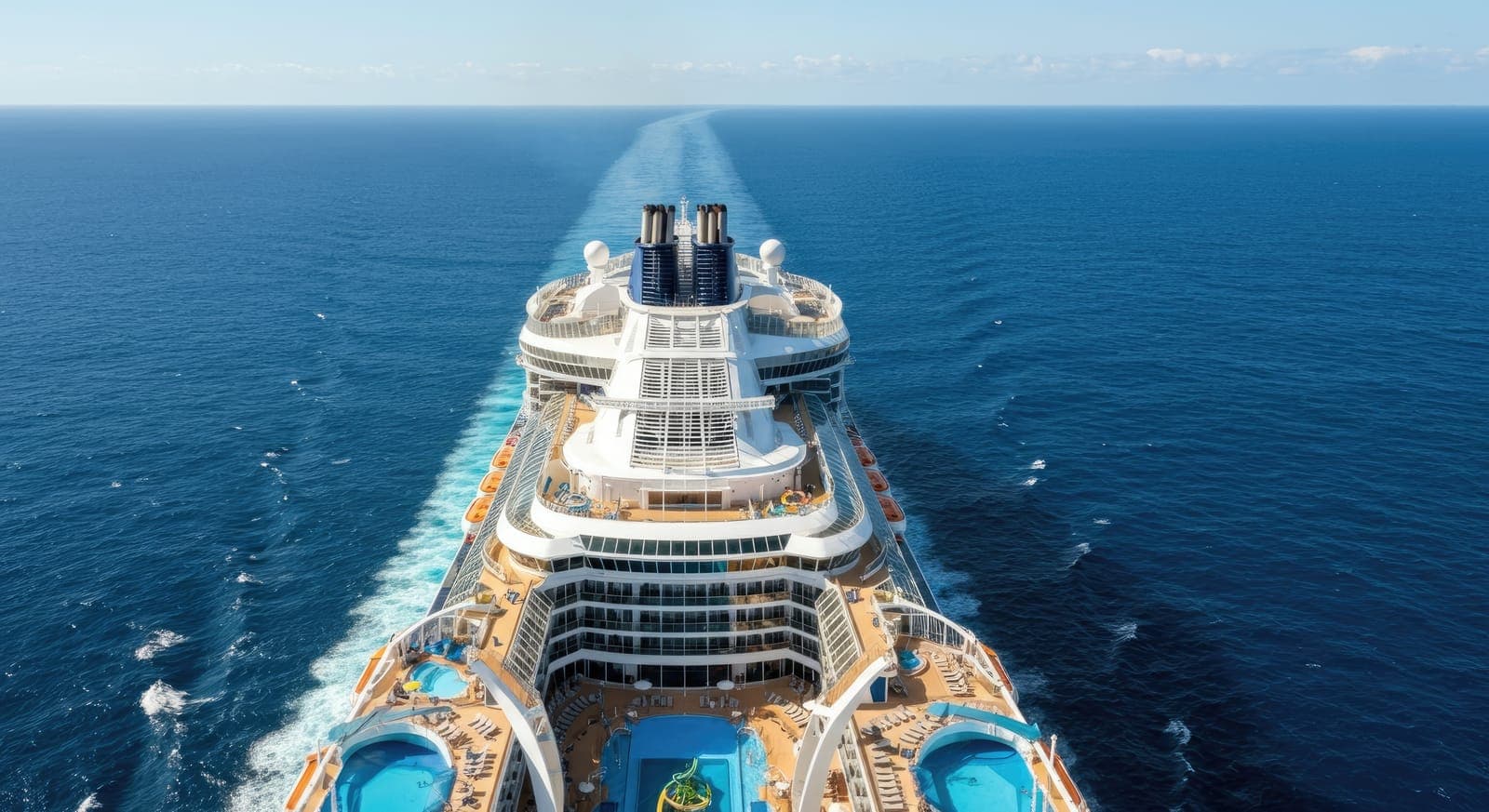
A 6,000-passenger cruise ship is basically a floating city. And like any city, it needs a constant supply of clean water and a way to deal with everything that goes down the drain. But there are no reservoirs at sea and no municipal sewer to plug into. So how does a ship surrounded by undrinkable saltwater keep tens of thousands of showers, sinks, ice machines, and toilets running? And once that water has been used, where does it actually go?
Most of the fresh water on a modern cruise ship is made on board, by turning seawater into drinking water through reverse osmosis and heat-powered evaporation. And a big ship can produce several hundred thousand gallons a day. The wastewater is then sorted into "greywater" and "blackwater," treated in onboard plants that rival small-town facilities, and discharged only under strict distance, speed, and treatment rules set by international law. Here's the full, slightly gross, genuinely fascinating story.
Why ships make their own water
You might assume cruise ships just fill up giant tanks in port and call it a day. Some water is loaded that way. A process called bunkering. But it's not the main event for a few reasons:
Space and weight. Water is heavy (about 8.3 pounds per gallon). Carrying days' worth of supply for thousands of people would cost enormous tank capacity and fuel.
Quality control. Port water quality varies wildly around the world. Making water on board gives the crew consistent control over purity.
Sheer volume. A modern cruise ship can use close to 400,000 gallons of water per day across drinking, cooking, laundry, pools, and cleaning, according to industry reporting. No reasonable tank farm keeps up with that.
So ships bunker some water as a backup or top-up, but the workhorses are the onboard desalination systems that pull it straight from the sea.
Method 1: Reverse osmosis (the brute-force squeeze)
Reverse osmosis (RO) is the more modern of the two main methods, and it's conceptually simple: push seawater through a membrane so fine that water molecules get through but salt and other dissolved solids don't.
The catch is the word "push." Seawater really doesn't want to give up its salt, so the system has to overcome osmotic pressure with serious force. High-pressure pumps drive seawater against semi-permeable membranes at roughly 800 to 1,000 psi, according to industry sources. What comes out the other side is fresh water; the leftover concentrated brine is returned to the sea.
A few things worth knowing about shipboard RO:
A single RO unit can produce on the order of 12–15 cubic meters per hour (roughly 3,200–4,000 gallons/hour), depending on seawater quality and membrane condition.
Cruise ships often run one to two RO units, sometimes alongside evaporators.
It's energy-hungry: seawater RO typically needs about 3 to 6 kilowatt-hours per cubic meter of water produced. Roughly 11–23 kWh per 1,000 gallons.
RO's big advantage is that it doesn't require a heat source, so it can run whenever there's electrical power.
Method 2: Flash evaporation / distillation (the steam trick)
The older, elegantly efficient method is distillation via flash evaporators. And ships have a clever reason to love it: free heat.
A cruise ship's engines throw off enormous amounts of waste heat in their cooling water, typically in the 75–95°C (167–203°F) range. Instead of dumping all that heat, evaporators use it to boil seawater under low pressure (lowering the pressure drops the boiling point, so the engine's "warm" water is hot enough). The seawater flashes to steam, leaving the salt behind, and the steam is then condensed back into pure fresh water.
Because they piggyback on heat the engines produce anyway, evaporators can be very economical to run while a ship is cruising. They're also high-capacity: a typical marine evaporator produces around 20–25 cubic meters per hour (roughly 5,300–6,600 gallons/hour).
Many ships run both technologies. Evaporators while underway when waste heat is plentiful, and RO to fill the gaps, including in port. Either way, the output is then mineralized, filtered, and disinfected (commonly with chlorine or UV) to meet drinking-water standards before it reaches a tap.
A quick word on light
One genuinely cool detail: the final disinfection step on many ships uses ultraviolet light. UV-C wavelengths scramble the DNA of bacteria and viruses without adding any chemicals, which is why the water that's already been squeezed or steamed clean gets a final pass under a glowing lamp before it's stored. Sunlight's invisible cousin, doing quality control in a steel tank deep inside the hull.
Now the gross part: where does it all go?
Make water, use water, create wastewater. A ship that produces hundreds of thousands of gallons a day also has to get rid of a comparable amount. And this is where it gets interesting. Cruise wastewater is split into two main categories.
Greywater vs. blackwater
Greywater is the wastewater from sinks, showers, laundry, dishwashers, and galley (kitchen) drains. It's dirty, but it's not sewage.
Blackwater is sewage. Drainage and waste from toilets, urinals, and medical facilities. This is what international law specifically defines and regulates as "sewage."
A large ship generates far more greywater than blackwater, simply because showering, washing dishes, and doing laundry happen constantly.
Advanced Wastewater Treatment Systems (AWTS)
Modern cruise ships increasingly run Advanced Wastewater Treatment Systems that work much like a land-based municipal sewage plant. Compressed into a fraction of the space. According to industry descriptions, these systems move waste through primary, secondary, and tertiary stages: filtering out solids, using biological processes to break down organic matter, and finally disinfecting to kill pathogens before any discharge. The treated effluent that comes out the far end is dramatically cleaner than raw waste.
The rules: MARPOL Annex IV and where discharge is allowed
What a ship can release, and where, isn't up to the captain's mood. It's governed by MARPOL Annex IV, the International Maritime Organization's rules on sewage pollution. The core requirements:
Ships of 400 gross tons and above on international voyages, carrying 15 or more people, must have either an approved sewage treatment plant, a holding tank, or both.
Untreated sewage may only be discharged at least 12 nautical miles from the nearest land, and only while the ship is proceeding en route at no less than 4 knots, at an approved discharge rate.
Comminuted (ground up) and disinfected sewage may be discharged beyond 3 nautical miles from shore.
Ships with an approved sewage treatment plant can discharge treated effluent closer to shore. But the effluent must not produce visible floating solids or discolor the surrounding water.
The "4 knots" and "en route" rules exist for a reason: a moving ship disperses discharge across a wide area of open ocean rather than dumping a concentrated load in one spot.
There are also stricter zones. Special Areas like the Baltic Sea, and No Discharge Zones designated under U.S. rules (enforced in coordination with the EPA), impose tougher limits. Including additional nitrogen and phosphorus removal standards for passenger ships in some Special Areas, and outright bans on discharge in sensitive waters. In places like the Arctic and Antarctic, ships are often required to hold greywater in storage tanks rather than release it.
Interestingly, greywater itself isn't directly regulated by MARPOL Annex IV. In much of the world, ships have historically been permitted to discharge greywater overboard without treatment. Which is exactly why responsible operators and regional regulators have pushed the AWTS approach to treat it anyway.
What about food waste and garbage?
Solid waste falls under a different rulebook, MARPOL Annex V, which covers garbage. The headline rules:
Food waste that's been comminuted or ground finely enough to pass through a 25 mm screen can only be discharged 3 nautical miles or more from the nearest land.
Food waste that hasn't been ground can only be discharged 12 nautical miles or more from land.
In Special Areas, only comminuted food waste may go overboard, and only at least 12 nautical miles out while the ship is en route.
Plastics may never be discharged at sea. Ever.
For the rest of the garbage stream, ships rely on a mix of onboard incineration, compaction, and offloading to shore facilities in port for recycling or landfill. One important wrinkle: incinerator ash is classified as operational waste, and dumping it into the sea is not permitted, it has to be landed ashore.
So the modern cruise ship is a closed-loop industrial operation: it manufactures its own drinking water from the ocean, sorts and treats what comes back out, and is bound by a thick book of international rules dictating exactly what can return to the sea, how far out, how fast, and how clean.
Curious how the rest of the ship works?
The water and waste systems are just one slice of the engineering that keeps a floating city running. If you found this fascinating, dig into:
FAQ
Can you drink the tap water on a cruise ship? Yes. Whether it's bunkered in port or made on board via reverse osmosis or evaporation, the water is filtered, mineralized, and disinfected (commonly with chlorine or UV light) to meet drinking-water standards before it reaches your cabin tap.
How much fresh water does a cruise ship make per day? It varies by ship size, but a modern large cruise ship can use close to 400,000 gallons of water per day, and much or most of that is produced on board rather than carried from port.
What's the difference between greywater and blackwater? Greywater is wastewater from sinks, showers, laundry, and kitchens. Blackwater is sewage from toilets, urinals, and medical facilities. Blackwater is what MARPOL specifically regulates as "sewage," and it faces stricter discharge rules.
Does the toilet waste just get dumped in the ocean? Not freely. Under MARPOL Annex IV, untreated sewage can only be released at least 12 nautical miles from land while the ship moves at 4 knots or more. Most modern ships treat sewage in onboard plants first, and many run Advanced Wastewater Treatment Systems that clean it to a far higher standard before any discharge, with even tighter rules in Special Areas and No Discharge Zones.
What happens to food waste and trash on a cruise ship? Food waste may be ground up and discharged at sea only at set distances from shore (3 nautical miles for comminuted waste, 12 for un-ground), per MARPOL Annex V. Plastics can never be discharged. Other garbage is incinerated, compacted, or offloaded to shore facilities, and incinerator ash must be landed ashore, not dumped at sea.