

Founder & Cruise Expert
Avid cruise enthusiast who cruised so many times he decided to make it a career. Ian has sailed on over 30 cruise lines across 6 continents, from budget-friendly Carnival sailings to luxury Regent Seven Seas voyages. He built CruiseShipTracking to help fellow cruisers track ships, plan voyages, and find the best deals.
Only one major cruise line, Cunard, allows pets aboard, and only on transatlantic crossings between New York and Southampton on the Queen Mary 2. Their onboard kennels accommodate dogs and cats. All other major cruise lines prohibit pets entirely, with the exception of trained service animals (not emotional support animals). If you cannot travel without your pet, Cunard transatlantic crossings and select European river cruises are your only options.
In This Article
We earn a commission when you book through our links at no extra cost to you. This does not affect prices. Learn more
Leaving a pet behind is one of the hardest parts of any vacation, and cruises make it particularly complicated. You'll be gone for 7-14 days on average, you're unreachable by car, and you can't simply cut the trip short if something happens with your animal.
The honest answer to "Can I bring my pet on a cruise?" is: almost certainly not. But there are a small number of legitimate options, and if you're determined to cruise with your furry companion, or need to plan the best care for them while you're away, this guide covers every angle.
Sailing with Cunard or service-animal-friendly? Browse cruise sailings on Cruisebound →
The Only Major Cruise Line with Kennels: Cunard

Cunard's Queen Mary 2 is the single ocean cruise ship from a major line that carries pets. Not every Cunard ship, and not every itinerary. Only the Queen Mary 2 on transatlantic crossings between New York (Brooklyn Cruise Terminal) and Southampton, UK.
The Kennel Program
The QM2 has 24 kennels, divided between dogs and cats, located on Deck 12. The program includes:
Individual kennel assignments. Dogs and cats are housed in separate areas
Dedicated outdoor exercise area. A lamp-posted "English garden" walking area on the top deck, complete with a fire hydrant
Daily feeding and watering. You provide the food; kennel staff handle the schedule
Owner visitation hours. You can visit your pet during designated times throughout the day (typically 3-4 sessions)
Pet-sitting when you're at dinner or events. Kennel staff monitor animals during owner absence
Bedding provided. Though many owners bring their pet's own blanket for comfort
Cost and Booking
Approximate cost: $500-1,000 per transatlantic crossing, depending on kennel size and season
Booking: Kennel spaces must be booked directly through Cunard. They sell out months in advance for summer crossings.
Deposit: A non-refundable deposit is typically required at booking
Maximum weight/size: Large dogs are accommodated, but kennel sizes vary. Contact Cunard directly to confirm your breed fits.
Requirements
Up-to-date vaccination records (rabies, distemper, bordetella)
Health certificate from your veterinarian dated within 10 days of sailing
Microchip identification
Proof of flea and tick treatment
UK-bound dogs must meet DEFRA (UK government) import requirements, including rabies titer test and tapeworm treatment administered 1-5 days before arrival
The Experience
Owners consistently report positive experiences. The kennel staff are attentive, the outdoor exercise area is well-maintained, and pets generally adjust well to the ship's motion (dogs seem to handle it better than cats). The main limitation is that your pet lives in the kennel. Not in your cabin. You cannot bring your animal to dinner, shows, or anywhere else on the ship beyond the kennel area.
A transatlantic crossing takes 7 nights, so your pet will spend a full week in the kennel with regular but limited time with you. Some pets handle this beautifully. Others find it stressful. Know your animal.

DIYMAG Magnetic Hooks 6-Pack
- Super-strong neodymium magnets stick to cabin walls and ceilings
- Hang hats, bags, towels, and lanyards anywhere
Cruise cabin walls are steel, magnetic hooks turn every surface into storage
View on Amazon
5-Pack Cruise Lanyards Waterproof
- Waterproof holders protect your cruise card at the pool and on excursions
- Five lanyards for the whole family
Your cruise card is your key, wallet, and ID, a waterproof lanyard keeps it safe and accessible
View on AmazonService Animal Policies by Cruise Line
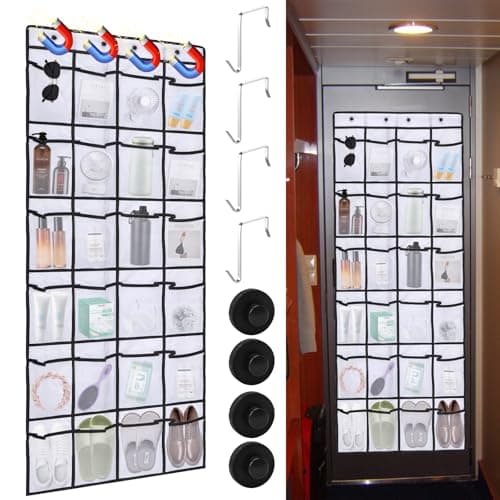
Cruise Door Organizer 24 Pockets Magnetic
- 24 clear pockets attach magnetically to the metal cabin door
- Holds sunscreen, lanyards, snacks, and small items
The single most recommended cruise hack, turns your cabin door into instant storage
View on AmazonAll major cruise lines accept trained service dogs aboard under the Americans with Disabilities Act (ADA) and equivalent international regulations. Here is what each line requires:
Cruise Line | Advance Notice | Documentation Required | Restricted Areas |
|---|---|---|---|
Royal Caribbean | 60 days | Task training documentation, vaccination records | Pools, hot tubs, spa, food prep areas |
Carnival | 30 days | Veterinary records, behavior attestation | Pools, spa, dining buffet stations |
Norwegian | 60 days | Task training letter, vet health certificate | Pools, spa, casino |
Celebrity | 60 days | Same as Royal Caribbean (same parent company) | Pools, spa, food prep areas |
Princess | 30 days | Vaccination records, task description letter | Pools, spa |
Disney | 30 days | Task training documentation, vet records | Pools, characters areas (select), food prep |
MSC | 60 days | Health certificate, training documentation, EU pet passport for European voyages | Pools, spa, buffet |
Holland America | 30 days | Vaccination records, task training letter | Pools, spa |
What Qualifies as a Service Animal
Under current regulations (aligned with ADA revisions and DOT rules), a service animal must be:
A dog. No other species qualifies. Miniature horses are accepted under ADA for land-based accommodations but are not accommodated on cruise ships.
Individually trained to perform specific tasks directly related to a person's disability. Guiding a blind person, alerting a deaf person, pulling a wheelchair, detecting seizures, providing deep pressure therapy for PTSD episodes, etc.
Under the handler's control at all times: housebroken, leashed or harnessed, and non-aggressive.
Your Responsibilities with a Service Dog
Relief areas: You must identify and use the designated relief area on the ship (typically a small section of an outside deck with artificial turf). You are responsible for cleanup.
Food and supplies: You bring all food, bowls, waste bags, and medications. The ship does not provide pet supplies.
Cabin: Your service dog stays in your cabin. You'll need to exercise the dog regularly on the designated deck.
Port days: You can take your service dog ashore, but some countries have strict animal import regulations. Caribbean islands generally allow service dogs. European and Asian ports may require advance paperwork. Confirm with the cruise line's accessibility department for each port on your itinerary.
The Emotional Support Animal Policy Change
Until 2021, many cruise lines accepted emotional support animals (ESAs) with a therapist's letter. That era is over.
What Changed
In January 2021, the U.S. Department of Transportation finalized rules that no longer require airlines to accommodate ESAs, reclassifying them as pets rather than service animals. Cruise lines followed suit within months:
Royal Caribbean stopped accepting ESAs in 2021
Carnival stopped accepting ESAs in 2021
Norwegian stopped accepting ESAs in 2022
Disney stopped accepting ESAs in 2021
All other major lines followed by mid-2022
Why the Change
The ESA system was widely abused. Passengers brought untrained dogs, cats, peacocks, and other animals aboard with letters purchased online for $50-200 from therapists who had never met the passenger. Incidents of animal aggression, cabin damage, and hygiene issues made the situation untenable for cruise lines.
If You Rely on an ESA
If you have a genuine mental health condition and your animal provides therapeutic support:
Talk to your therapist about whether a trained psychiatric service dog (PSD) is appropriate. PSDs are trained to perform specific tasks (alerting to anxiety attacks, providing deep pressure therapy, interrupting self-harm behavior) and qualify as service animals.
The training matters. A dog that simply provides comfort by being present does not qualify. The dog must be trained to perform identifiable tasks.
Programs exist to train your existing dog as a psychiatric service dog, though certification takes months and the dog must pass public access tests.
Consider medication adjustments with your psychiatrist for the duration of the cruise if your ESA cannot qualify as a service animal.
River Cruises with Pets
If ocean cruising won't accommodate your pet, European river cruises offer limited options:
CroisiEurope (France)
The most pet-friendly cruise operator in Europe. CroisiEurope allows small dogs (generally under 15 kg / 33 lbs) on most European river sailings at no additional charge. Dogs stay in your cabin and are permitted in most public areas except the restaurant during meal service. The company is family-owned and French, and the French relationship with dogs in public spaces is notably more relaxed than the American one.
Routes available with pets: Rhine, Danube, Seine, Rhone, Douro, and select canal cruises.
A-ROSA (Germany)
A-ROSA permits small dogs on many of their Rhine and Danube sailings. A supplemental cleaning fee of approximately 50-80 EUR is charged. Dogs must be leashed in public areas and are not allowed in the restaurant or spa. On-deck walking areas are available.
Nicko Cruises (Germany)

OlarHike 10-Set Compression Packing Cubes
- Ten-piece set includes multiple sizes plus shoe bag and laundry bag
- Color-coded for easy family organization
Families sharing a cabin need maximum organization, 10 cubes cover everyone
View on AmazonSelect sailings allow small dogs with advance notice. Policies vary by ship and itinerary, confirm directly with the operator.
AmaWaterways, Viking, Uniworld, Avalon
None of these major river cruise operators accept pets. Viking has been the most frequently asked and has consistently said no.
American River Cruises
American Queen Voyages (now part of the Hornblower Group), American Cruise Lines, and UnCruise Adventures do not accept pets on any sailings.
Best Alternatives for Pet Owners
If bringing your pet isn't an option, here are the most reliable care solutions while you cruise:
Professional In-Home Pet Sitting
A sitter stays in your home with your pet, maintaining their routine.
Cost: $25-75/day depending on your city and the sitter's experience
Platforms: Rover, Care.com, local pet-sitting businesses
Pros: Minimal disruption to your pet's routine, your home is occupied (security benefit), one-on-one attention
Cons: You're trusting a stranger in your home, sitter quality varies
Tip: Do a trial overnight before your cruise. Use a sitter with verified reviews and insurance coverage. Install a pet camera (Wyze, Blink, Furbo) so you can check in when you have ship WiFi.
Boarding Facilities
Your pet stays at a dedicated facility.
Cost: $30-80/day for dogs, $20-45/day for cats
Types: Basic kennel runs, cage-free boarding, luxury pet hotels with webcams and play sessions
Pros: Professional staff, emergency vet access, socialization for social dogs
Cons: Stressful for anxious or senior pets, exposure to illness (kennel cough), impersonal environment
Tip: Visit the facility in person before booking. Ask about staff-to-animal ratios, ventilation, exercise schedules, and their protocol for medical emergencies. Confirm they'll administer any required medications.
Friends and Family
The most trusted option, if available.
Cost: A nice gift or reciprocal pet-sitting
Pros: Your pet knows and trusts the person, flexible arrangements
Cons: You're asking a significant favor for 7-14 days, not everyone is equipped to handle pet emergencies

Aerotrunk Compression Packing Cubes 4-Pack
- Double-zipper compression cuts volume by up to 60%
- Four sizes cover every clothing type
Compression cubes are the single best way to fit a week of cruise outfits into a carry-on
View on AmazonHouse-Sitting Exchanges
Platforms like TrustedHousesitters connect travelers with sitters who stay in your home for free in exchange for pet care.
Cost: Annual membership fee ($129-259/year for TrustedHousesitters)
Pros: Free pet care, your home is occupied, sitters are typically experienced travelers who love animals
Cons: You're hosting a stranger, less accountability than paid services
Preparing Your Pet for Your Absence
Regardless of which care option you choose, these steps reduce stress for your pet:
Gradual separation. If your pet isn't used to being without you, practice with overnight stays at the boarding facility or with the sitter 2-4 weeks before your cruise.
Written care instructions. Leave a detailed document covering feeding schedule, medication timing, vet contact information, emergency authorization, behavioral quirks, and comfort items.
Vet check before you go. Ensure vaccinations are current (boarding facilities require this), stock up on medications, and discuss any anxiety management options with your vet.
Leave familiar items. A worn t-shirt with your scent, their favorite toy, and their regular food (don't switch brands before a trip).
Emergency authorization. Leave a signed letter authorizing your pet sitter to approve veterinary treatment up to a specified dollar amount in your absence. Some vets won't treat without owner authorization.
Quick Decision Guide
Your Situation | Best Option |
|---|---|
You want to cross the Atlantic with your dog | Cunard Queen Mary 2 transatlantic crossing |
You have a trained service dog | Any major cruise line with 30-60 days advance notice |
You want a European river cruise with a small dog | CroisiEurope or A-ROSA |
You have an ESA (not task-trained) | Leave pet with sitter; discuss PSD training with therapist |
You have a cat | Cunard QM2 (transatlantic only) or home-based pet sitting |
You have an exotic pet (bird, reptile, etc.) | Home-based pet sitting only; no cruise option exists |
The Bottom Line
Cruising with a pet is possible in exactly one scenario on the open ocean: Cunard's Queen Mary 2 transatlantic crossing with their onboard kennel program. For everything else, you're looking at professional pet care at home.
The good news is that pet-sitting services have improved dramatically. Between in-home sitters, cage-free boarding facilities, pet cameras, and house-sitting exchanges, your pet can be well cared for while you enjoy the Caribbean. Plan the pet care with the same attention you give to booking excursions, and you'll board the ship with less worry.
Check our ship tracker to follow Queen Mary 2's transatlantic routes, or browse Cunard's profile for more details on their fleet and itineraries.